From strategy to action: Turning innovation into real value
What if what works today won’t be enough tomorrow? And how can the strengths we already have continue to create value in the future?
These are the questions driving ÆRA’s work with strategic innovation and realization.

While strategy is about gaining clarity on core capabilities, competitive advantages, and future opportunities, realization is about putting those ambitions to the test. It means to validating real needs, willingness to pay, and the organization’s ability to develop and deliver profitable - or genuinely value-creating - solutions in the real world. Learning fast, adjusting along the way, and making decisions based on experience rather than assumptions are key.
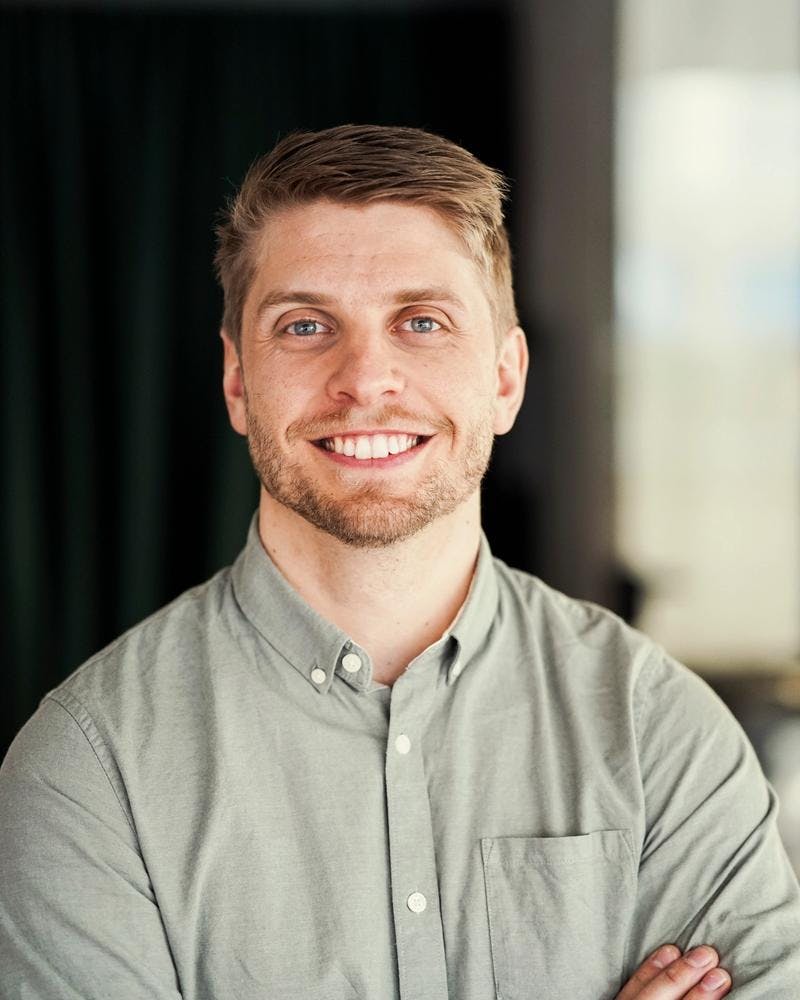
As Innovation Lead, Christian Haave has worked with this approach since 2022. He partners with organizations across sectors to turn strategy into action. Here at ÆRA, he shares insights from recent projects and his thoughts on what it will take to create value in the years ahead.
Christian, to start; You work as an Innovation Lead at ÆRA. What does that role look like in practice?
At its core, my job is to help organizations create new or greater value through strategic innovation. A lot of that work is about opening up new perspectives and shifting the conversation from “who are we today?” to “who do we need to be tomorrow?”
It’s also about being clear about the role an organization should have going forward, and what products, services, and value it should offer. That means challenging established truths, exploring new opportunities, and helping leaders make concrete choices based on where they actually have an advantage. And just as importantly: acting on those choices.
In a world driven by digitalization and AI, access to trends and data is no longer a differentiator. Everyone has it. The challenge is that we have no data about the future. At ÆRA, we therefore have a focus on qualitative approaches to uncover insights others miss, especially in complex or emerging areas. We look for subtle signals in what’s happening right now, and those insights often open up new opportunities with real competitive potential.
Another big part of my role is alignment and ownership. Innovation becomes more complex when many stakeholders are involved, but it also results in longer-lasting solutions. Broad involvement helps create better concepts, clearer priorities, and a shared story that people actually commit to.
While strategy is typically revisited every three to five years, realization work provides methods, language, and experience that organizations can use every day to execute on strategy and to continue evolving it.
What’s your background, and what led you to ÆRA?
I have a master’s degree in business administration, with a focus on strategy, innovation, and entrepreneurship. I started my career at The Norwegian Labour and Welfare Administration, NAV, as a business advisor, helping refugees enter the workforce and society. Later, I worked in Bærum Municipality as a process lead and innovation advisor. I worked with innovation projects of all sizes and followed them from cradle to grave. This experience taught me how critical it is to take the user perspective seriously and to test solutions with real people, not just discuss them in meeting rooms.
I’ve always been curious about how businesses can create better outcomes for both people and the planet. Honestly, I didn’t think a company like ÆRA existed until I came across them on LinkedIn. After a job posting and several great conversations, it became clear that this was a place where ambition, values, and action truly align.
What projects are you focused on right now, and why do they matter?
Lately, I’ve spent much of my time helping clients develop and test new concepts directly in the market, drawing on extensive insights and exploring new strategic areas for new value creation opportunities. This can involve new products, services, user groups, channels, or business models, or often several dimensions at the same time.
One project I’m especially proud of is a small circular pilot where we tested the use of reusable cups at football stadiums. Even though it was limited in scale, it faced the same challenges as much larger circular initiatives: changing user behaviour, missing value chains, and the need to coordinate many actors, from design and logistics to washing and operations.
What’s exciting is that we built a functioning value chain using existing components. By testing with a consortium of partners, including the soccer club Stabæk, the Norwegian top-level soccer organization Norsk Toppfotball, Bærum Municipality, and the municipality-owned work inclusion organization ARBA, we’ve learned a lot. The project demonstrates how organizations can experiment their way from linear to circular solutions, with the potential to scale them over time.

ÆRA has done a lot of realization work in recent years. How would you describe this offering?
In realization projects, we work closely and hands-on with clients to test hypotheses about target groups, concepts, and growth initiatives. Instead of debating what might work, we focus on testing what actually works in practice.
This gives clients concrete data, insights, and a much stronger foundation for decision-making. Often, these are ideas that emerged in strategy processes or concepts that have been around for a long time and finally deserve to be tested in the real world.
Realization is also about building capability. While strategy is typically revisited every three to five years, realization work provides methods, language, and experience that organizations can use every day, to execute on strategy and to continue evolving it.
What changes do you see in organizations that go through a realization process?
The biggest shift is in mindset. Once organizations understand both why and how to test, the threshold for engaging with markets or stakeholders drops dramatically.
Over time, they build a kind of internal “experience library” that informs future product development, portfolio choices, and strategic decisions. Many also begin exploring innovation beyond their usual comfort zones, such as services, partnerships, or new business models.
There’s also a strong organizational effect. Testing together, close to reality, builds learning, confidence, and stronger teams.
Should we include other arenas than markets as well? I.e., we also experiment with the public sector.

How are markets and stakeholders involved?
A core principle for us is that ideas and concepts must be tested with real people. We can’t sit in isolation and invent solutions; we need to get out into the field and gather reactions, traction, and sometimes resistance.
We often involve a wide range of stakeholders and societal actors, depending on the project. In one recent case, where a client wanted to explore young people as a new target group, we involved students as well as potential strategic partners who could play a role in future commercialization.
How does this differ from traditional business development?
We often launch something unfinished early, a mock-up, a draft, a visualization, to learn faster. That can feel uncomfortable, but the insights are invaluable. At the same time, we combine this approach with deep expertise in design, sustainability, social anthropology, and business development.
By making smaller investments across several dimensions before scaling, we reduce risk and increase confidence in what we eventually bring to market.
What has changed in realization in recent years?
Digital tools and AI have made it faster and cheaper to build prototypes. Early testing is almost cost-free, and we actively make use of all these digital tools in our prototyping. However, I want to point out that we maintain a healthy scepticism toward tools, platforms, power structures, and the broader impact of technology on organizations and society.
And I would like to add that meaningful innovation, made more tailored and efficient through technology, is still hard work. Real value only appears when ideas meet real people and when external perspectives are truly absorbed by the organization. Strategic innovation is complex, but realization can be approached just as systematically as operations or core business.
What are clients most focused on right now?
Many are less interested in simply developing a strategy and more focused on working with it. They want to test the strategy in practice and understand what it actually means for products, services, and organizational design.
At the same time, I think we at ÆRA may underestimate how much experience we have in operationalizing strategy. We have over 100 years of combined experience, yet we approach every project with humility and curiosity. We use proven tools, processes, and knowledge in a modular way, recombining them to fit each unique context. That’s something we do well.

Finally: It’s 2030. What do you hope ÆRA has achieved?
One of the best things about working at ÆRA is the people: colleagues, clients, and partners who genuinely want to make a difference. In times of uncertainty and complexity, it’s important to stay grounded in why we innovate: to preserve what we value, while adapting it to new contexts.
By 2030, I hope that the progressive solutions we’ve developed together with our clients have truly become the new way of doing things. I also hope, of course, that we have delivered many more projects that drive meaningful change and leave a positive impact on people, businesses, and the planet, while creating greater stability for those who come after us.
Contact
Related articles


